The Invention of Solitude by Paul Auster
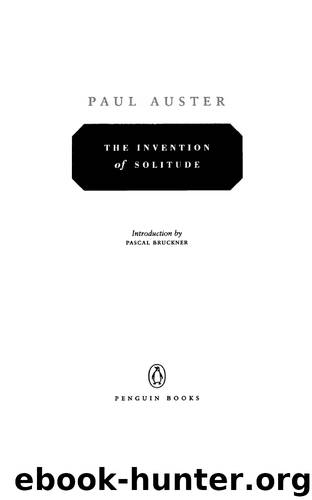
Author:Paul Auster [Bruckner, Pascal]
Language: eng
Format: epub, mobi
ISBN: 9781101562864
Publisher: Penguin Group US
Published: 2007-01-29T16:00:00+00:00
Toward the end of Hölderlin’s life, a visitor to the tower mentioned Suzette’s name. The poet replied: “Ah, my Diotima. Don’t speak to me about my Diotima. Thirteen sons she bore me. One is Pope, another is the Sultan, the third is the Emperor of Russia….” And then: “Do you know what happened to her? She went mad, she did, mad, mad, mad.”
During those years, it is said, Hölderlin rarely went out. When he did leave his room, it was only to take aimless walks through the countryside, filling his pockets with stones and picking flowers, which he would later tear to shreds. In town, the students laughed at him, and children ran away in fear whenever he approached to greet them. Towards the end, his mind became so muddled that he began to call himself by different names—Scardinelli, Killalusimeno—and once, when a visitor was slow to leave his room, he showed him the door and said, with a finger raised in warning, “I am the Lord God.”
In recent years, there has been renewed speculation about Hölderlin’s life in that room. One man contends that Hölderlin’s madness was feigned, and that in response to the stultifying political reaction that overwhelmed Germany following the French revolution, the poet withdrew from the world. He lived, so to speak, underground in the tower. According to this theory, all of the writings of Hölderlin’s madness (1806–1843) were in fact composed in a secret, revolutionary code. There is even a play that expands upon this idea. In the final scene of that work, the young Marx pays Hölderlin a visit in his tower. We are led to presume from this encounter that it was the old and dying poet who inspired Marx to write The Economic and Philosophical Manuscripts of 1844. If this were so, then Hölderlin would not only have been the greatest German poet of the nineteenth century, but also a central figure in the history of political thought: the link between Hegel and Marx. For it is a documented fact that as young men Hölderlin and Hegel were friends. They were students together at the seminary in Tübingen.
Speculations of this sort, however, strike A. as tedious. He has no difficulty in accepting Hölderlin’s presence in the room. He would even go so far as to say that Hölderlin could not have survived anywhere else. If not for Zimmer’s generosity and kindness, it is possible that Hölderlin’s life would have ended prematurely. To withdraw into a room does not mean that one has been blinded. To be mad does not mean that one has been struck dumb. More than likely, it is the room that restored Hölderlin to life, that gave him back whatever life it was left for him to live. As Jerome commented on the Book of Jonah, glossing the passage that tells of Jonah in the belly of the whale: “You will note that where you would think should be the end of Jonah, there was his safety.”
“The image of
Download
This site does not store any files on its server. We only index and link to content provided by other sites. Please contact the content providers to delete copyright contents if any and email us, we'll remove relevant links or contents immediately.
Waking Up in Heaven: A True Story of Brokenness, Heaven, and Life Again by McVea Crystal & Tresniowski Alex(37764)
Still Foolin’ ’Em by Billy Crystal(36327)
Cecilia; Or, Memoirs of an Heiress — Volume 1 by Fanny Burney(32523)
Cecilia; Or, Memoirs of an Heiress — Volume 2 by Fanny Burney(31928)
Cecilia; Or, Memoirs of an Heiress — Volume 3 by Fanny Burney(31912)
Fanny Burney by Claire Harman(26579)
Empire of the Sikhs by Patwant Singh(23057)
We're Going to Need More Wine by Gabrielle Union(19019)
Hans Sturm: A Soldier's Odyssey on the Eastern Front by Gordon Williamson(18550)
Plagued by Fire by Paul Hendrickson(17391)
Out of India by Michael Foss(16837)
All the Missing Girls by Megan Miranda(15878)
Cat's cradle by Kurt Vonnegut(15293)
Pimp by Iceberg Slim(14461)
Molly's Game by Molly Bloom(14119)
Bombshells: Glamour Girls of a Lifetime by Sullivan Steve(14036)
For the Love of Europe by Rick Steves(13791)
Leonardo da Vinci by Walter Isaacson(13282)
4 3 2 1: A Novel by Paul Auster(12352)
